Redeemer Arts

Redeemer Presbyterian Church, New York City
Showing posts with label material. Show all posts

Friday, August 5, 2011

The Reality of Abundance

On the table of pine

Stood a tiny Bowl of Blackberries (click to listen)

You poured into it the whitest cream.

In the corner her tail

Wrapped around her tiny body

As herself she did softly clean.


Outside on the lawn

Gently blowing the linen

Almost as if it were a dream.

And in the porcelain sink

My sorrows deep.

Pulled the drain and

I sent them out to sea.

My only wish,

For this.

My only wish,

For more of this

by Jonny Rodgers. See it live at the next InterArts.
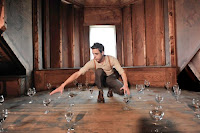

Something in Jonny Rodgers depiction of that tiny bowl of blackberries served with cream on a picnic table re-affirms for me a sense of the reality of Abundance. There is a place or person somewhere in the universe that truly fulfills the last aching abyss of the human heart. It is only a sense in my deepest heart of hearts, but could there be some validity to this feeling?

Everything in our culture seems to operate at a deficit, home loans, car loans, student loans, national debt....Yet our individual hopes and desires perhaps are running the highest deficit of all. I look at hundreds of faces each day riding the subways. I look at my own face reflected on my desktop as I write. Contentment seems even more elusive today than the large, dark creature I thought I saw while peering intently into the waters of Loch Ness at age sixteen.

When C.S. Lewis refers to our having desires which cannot be satisfied in this life, he hardly seems to paint a picture of Abundance. He does however conclude that we must, then, be made in fact for another world, suggesting the afterlife which is central to the Christian belief in resurrection. Still, it is difficult in the midst of our longings to find comfort merely in the hope of a life to come. Don’t you agree?

The Police, in their harrowing anthem Spirits in the Material World make a similar observation to Lewis’ but arrive at quite a different conclusion. Where does the answer lie, living from day to day? If it’s something we can’t buy, there must be another way. We are spirits in the material world. The answer for Sting seems to be a realization that life in the body is somehow of less consequence than a disembodied life would be. The song gives me a sense of needing to escape my body, a sentiment which was so heart-wrenchingly expressed by the character Evan in Justin Lerner’s recent New York film premiere, Girlfriend. Actor Evan Sneider delivers a stealth performance as a young man with Down’s syndrome who falls in love with a beautiful and troubled single mother in a rural suburb. For Evan, being in his physical body seemed to keep him from his desire for romantic love. Rocking out at my desk to The Police performing this incredibly virile song leaves me with a feeling that we’d all be better off if we could only escape our bodies and live a purely ephemeral, spiritual life. It’s little wonder that the opening lines to the song decry contemporary efforts to reform society or the human condition. Why engage in politics, religion or even relationships if there's no real hope?Indeed, there must be another way.

Being a song-writer and a follower of Christ I am trying to understand the tension between recognizing the brokenness in my own heart and life, and allowing that brokenness to take over my view of myself and the world. If it weren’t for my pain, I wouldn’t have much to share with others. On the other hand, I also have this notion in my gut, having met the resurrected shepherd, that even the darkest night will one day be a distant memory in the face of such beauty as He possesses and which He will one day restore to all things. Living in this hope means loving Abundance: loving the world while regarding only one thing as most precious. That thing is a person, whose mystery is enough to tickle the laughing/crying soft flesh of our longing. Yet, He is master enough to restore all things. The reality of Abundance stares us back in the face through the eyes of this mysterious and masterful person. In holding him dear, all things become dearer to me.

Kenyon


Friday, March 18, 2011

New City

In the book of Revelation John is shown the bride of the Lamb exemplified as a brilliant city coming down from heaven. This is not a city fabricated from steel and poured concrete. Instead we find purified gold, excavated stones, cut jasper, emerald, and sapphire. Its gates are colossal pearls plucked from the deep. This city holds an overwhelming material presence and bids us to use all of our senses.

Why this solid, tactile description? Are we, the bride, the Holy City, called to be a magnificent material presence— beckoning touch to ascertain its reality? Like John, let’s be carried away by the Spirit to behold such a visceral image of what we are to become. For in our present state we are raw material in need of being purified, excavated, cut, purged and plucked. Our rough surfaces and extraneous burrs must be smoothed away to reveal true beauty.

As Christians, and as artists, we do not disregard the material despite its flaws; we view possibilities. We wrestle, almost battle, to materially manifest ideas, distill insights. Jesus comprehends the painful process of creating, the exertion needed to dig up what must come to light. What makes the city in the book of Revelation a work of art is its thoroughly worked-over presence.

Artists, as we watch the horrors of Japan unfold, let us be reminded of John’s vision. It was the angel who held the seven bowls of plagues that took John by the hand to show him the New Jerusalem. It takes pain and process to make us more real, more solid, more beautiful. This is the nature of both Christianity and art.

--Maria

Friday, October 1, 2010

Working Out Of The Resurrection

Just as Jesus becomes the face of the Father, his broken and resurrected body gives access to the Spirit, who helps us live a renewed life. According to N.T. Wright, from the moment of the resurrection, “the forces of decay and death have suffered their major defeat, and from now on new creation is under way, with its first signs being the new life of those who believe the Gospel.” (The Redemption, p.84) Wright understands how the resurrection not only impacts our future, but is a reality that transforms Christians in the here and now. Therefore, Beth Felker Jones is correct in stating “Resurrection doctrine is indicative not only of final hopes, but also of present attitudes toward the bodies of the living.” (Marks Of His Wounds, p. 4) Jones believes God revealed himself through our senses by the Spirit which “has granted us the body of the Son.” It is through a broken body, that new life emerges. What this means for artists is amid the brokenness, “we can invoke nature with proper care…we can appeal to the nature of our own bodies, as we know it through the risen body of Jesus who is the paradigm of our own redemption.” (Marks Of His Wounds, p.100)

Life with the Spirit transforms our thinking about bodies and bestows a new attitude towards the things of this world. In her book Marks of His Wounds Jones directs us to the Augustinian understanding of embodiment and our inordinate desires. Our bodies and the material world are not necessarily the source of our sins; it is our disproportionate desires for these things. Through the Spirit, it becomes possible to possess a right relationship with God, that reorders our desires appropriately. Our art, then, becomes the means through which we can understand God and the world in a deeper way, not an end unto itself. By the Spirit, the material realm no longer enslaves, instead, we become free to value and nuture the things of this world, including art and the things it points to. Miroslav Wolf understands having dominion over the natural world means being responsible for God’s created order not “simply the satisfaction of human needs and wants.” (Work in the Spirit,p. 147) Thus, through the Spirit, we fulfill the Cultural Mandate, not because we must, but because we long to. Christ’s resurrected body prompts our desire to see all things become new again. Therefore the resurrection, according to Paul, allows us to give ourselves “fully to the work of the Lord,” this includes our art making endeavors, because we know that our “labor in the Lord is not in vain.” (1 Corinthians 15:58)

--Maria